A new paper authored by 92 scientists from around the globe that was posted online this weekend could settle some major questions about the subcontinent’s history and what that means for various theories of Indian civilisation. The paper, titled “The Genomic Formation of South and Central Asia,” which still has to go through peer review, uses genetics to examine the ancestry of ancient inhabitants of the subcontinent. Below is a quick summary of what you need to know.
There are 92 named authors on the study, including scholars from Harvard, MIT, the Russian Academy of Science, the Birbal Sahni Institute of Paleosciences in Lucknow, the Deccan College, the Max Planck Institute, the Institute for Archaeological Research in Uzbekistan and the Centre for Cellular and Molecular Biology, Hyderabad. Among the co-directors of the study is geneticist David Reich, whose new book has inspired much recent discussion about ancient human history and racial theory.
The researchers looked at genome-wide data from 612 ancient individuals, meaning DNA samples of people that lived millennia ago. These included samples from eastern Iran, an area called Turan that now covers Uzbekistan, Turkmenistan and Tajikistan, Kazakhstan, and South Asia. Of the 612, the DNA of 362 ancient individuals was being examined for the first time. They then compared this data with that taken from present-day individuals, including 246 distinct groups in South Asia.
A lack of sufficient ancient DNA as well as proper inquiry into the matter has meant that we still do not understand how central and South Asian populations were formed. There have been various theories about this, with some very closely connected to politics both in South Asia and abroad. The Nazis, for example, helped propagate the Aryan Invasion Theory in which blue-eyed fair people swept into the Indian subcontinent on horses, conquering everyone they saw along the way. Hindutva proponents have argued the opposite altogether, what is known as the Out-of-India theory, claiming that, if anything, Indo-European languages originated in India and spread out westward from there.
DNA and other human science-based research has thrown up confusing signals in the past, with mitochondrial DNA, which is only transferred from female to female, being mostly unique to the subcontinent. This suggested that the inhabitants of India have been indigenous for thousands of years. However, Y chromosomes, which are passed from male to male, showed much more connection to West Eurasians, whether Europeans, people of the Irani plateau, or Central Asians.
Amid all this, there is the question of whom the Indus Valley people were. Were they more connected to those we now know as Dravidians, only to be pushed south by migrating Aryans? Or were they themselves Aryans, who eventually moved southward?
In many ways, the study set out to resolve this contradiction and answer some part of the question: Who are the people of the subcontinent and how did they get there?
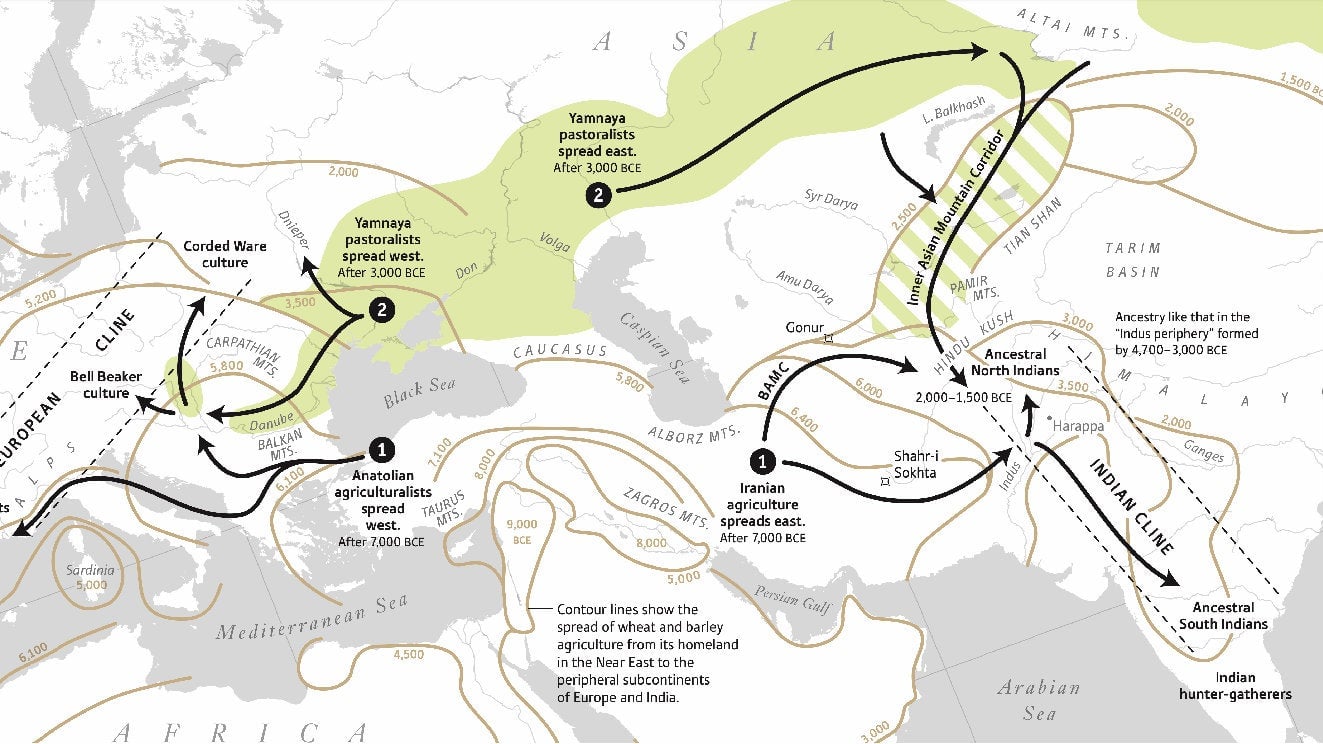
The paper, which you can read in full here, builds on the genetic understanding that there were two separate groups in ancient India: Ancestral North Indians and Ancestral South Indians, or ANI and ASI. These two groups were, as Reich explains in his new book, “as different from each other as Europeans and East Asians are today.” But where do these two populations, which solidify in around 2000 BCE, come from?
There are three potential groupings that, when mixed in various combinations, could be responsible for the creation of the Ancestral North Indian and Ancestral South Indian populations.
There is another important population with South Asian connections that sits somewhere amidst these three: the Indus Valley population.
In Turan, the area north of modern-day Iran also known as the Bactria-Margiana Archaeological Complex, there was a huge community of ancient people who seem to have little genetic connection with the inhabitants of the subcontinent. Yet the authors found three individuals from this ancient complex that did have some connection to India, specifically an ancestry mix of Iranian agriculturists and South Asian hunter-gatherers or Ancient Ancestral South Indians. This matched individuals from the Swat Valley in Pakistan, another Indus Valley site. Because the researchers didn’t have direct access to ancient DNA from India’s Indus Valley sites, the paper prefers to call them Indus Valley periphery individuals. These three individuals are key to the findings.
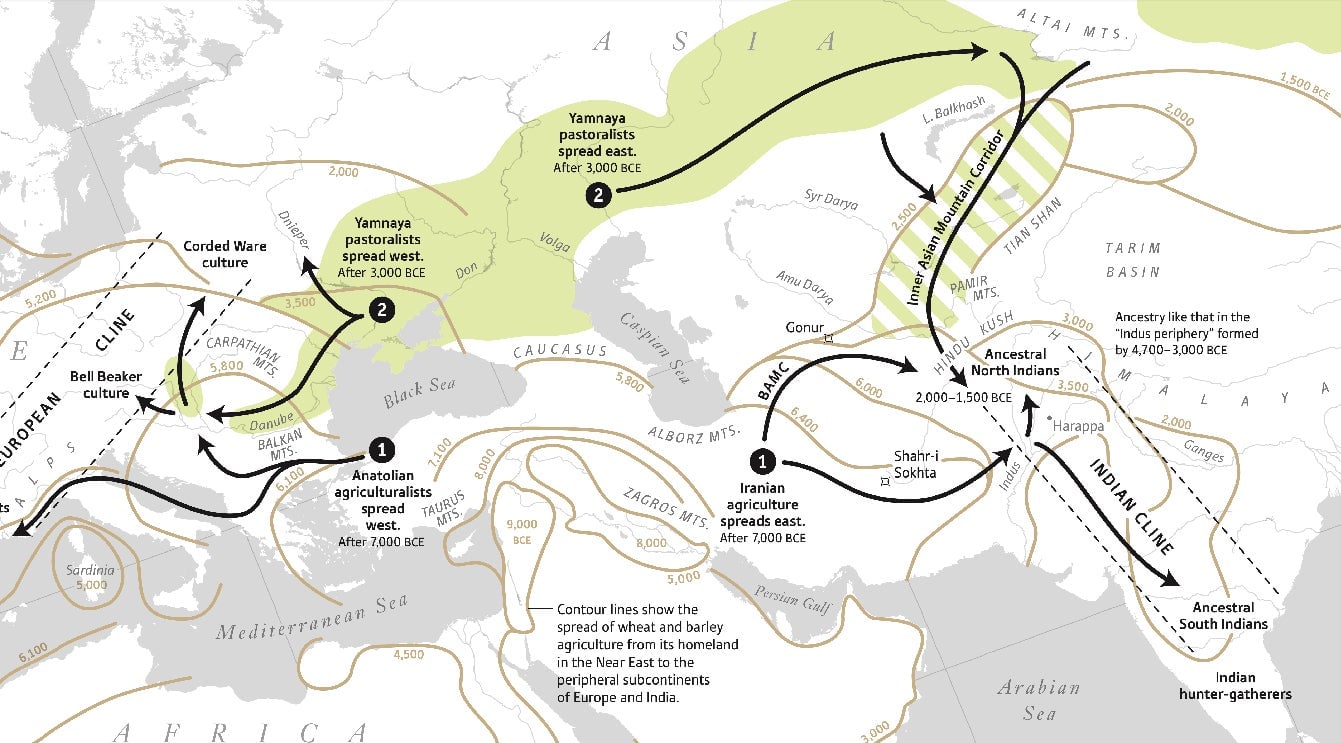
The reason the researchers call them Indus Valley periphery individuals is because they cannot be sure that their genetic makeup is the same as most of those who lived in the Indus Valley, because they did not have access to ancient DNA from Indian sites. But for the most part they seem to use these individuals as proxies for the people of that civilisation.
The make-up of Indus Valley periphery individuals is straightforward: a mixture of Iranian agriculturists and the South Asian hunter-gatherers, or Ancient Ancestral South Indians.
The study finds that these two ancestries are also there in both of the subsequent populations, of Ancestral North Indians and Ancestral South Indians, except for a couple of key differences.
This also means that the people of the Indus Valley Civilisation are the bridge to most extant Indian populations. “By co-analyzing ancient DNA and genomic data from diverse present-day South Asians, we show that Indus Periphery related people are the single most important source of ancestry in South Asia.”
Many things that would be hard to summarise. Journalist Tony Joseph, explains a number of implications in this piece, but here are a few main ones:
This piece was first published on Scroll.in. We welcome your comments at [email protected].
